Bits and pieces of my Carnation Mush historic research are all over the web, but it’s time to put it all in one place.
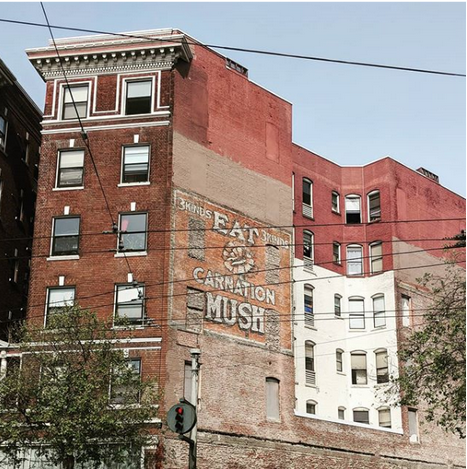
This definitive guide to all things Carnation Mush is inspired by the Carnation Mush sign on Market Street, which is one of my favorite ghost signs in the entire Bay Area. Revealed in 2011 when the adjacent building was demolished, I never expected it to still be here going on fifteen years later! That sign has an uncanny ability to survive new development, an ability that most of San Francisco’s ghost signs seem to lack. So if any San Francisco ghost sign deserves a detailed hagiography, it would be this Carnation Mush Sign (and its twin in North Beach).
What Was Carnation Mush
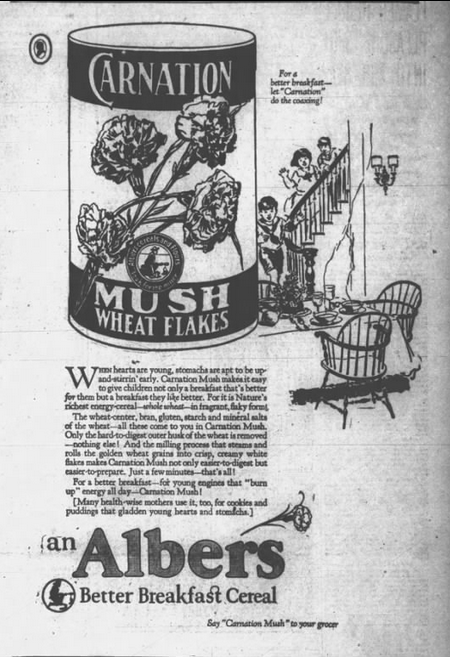
First things first, let’s get some of the backstory out of the way – what is Carnation Mush? Carnation Mush was a subsidiary of Albers Bros Milling Company that sold hot breakfast cereals. You might have seen another Albers Bros ghost sign on the Victoria Theater in the Mission, or next to the Northwest Broadway Bridge in Portland, Oregon.
Albers Bros Milling Company — originally known as Albers & Tuke —was formed in Portland, Oregon in 1893 by German immigrant Bernard Albers. Born to a milling family, when his brothers Henry, William, George, and Frank immigrated to the US they would join in on Bernard’s business, eventually reincorporating it as Albers Bros Milling Company in 1901. The oldest online references to Carnation Mush I have found are from 1902, so it seems like they launched the sub-brand pretty soon after incorporating as the Albers Bros Milling Company.
With mills in Portland, Seattle, Tacoma, San Francisco, Oakland, Los Angeles, and Ogden, Albers Bros Milling Company dominated the West Coast market for various kinds of flours, grains, cereals and even livestock feed; some marketed under the Albers’ name, while others were marketed under sub-brands like Carnation, Peacock, Del Monte, Sunripe, and Violet. With so many mills located in convenient deep water ports, they also did strong business in Asia and up the Canadian/Alaskan coast, making lots of money supplying hay (a grain by-product) to the US Army during the Spanish American War and flours/grains to gold miners during the Klondike Gold Rush.
By the late 1920’s, all five Albers brothers had either passed away (Bernard died in 1908), been arrested for violating the Federal Espionage Act (that would be Henry), or were nearing retirement age (William, George, and Frank). After years of rivalry and sustained trademark pressures by the Carnation Milk Products Company – who did not appreciate the name of their Carnation line – the entire Albers Bros company was officially acquired by Carnation Milk in 1929. While this was largely done to protect their brand and name, a milk company buying a cereal company does make a lot of business sense, and so they decided to continue operating the Albers Bros Milling Company.
Carnation Milk would continue to do so until 1984 when it was sold to Nestle. And Albers Brothers still exists! It’s under the Continental Mills umbrella now, although its offerings have been reduced to yellow corn meal, white corn meal, and quick grits.
Carnation Mush, however, does not still exist. The most recent references I have found to it are from 1940. Which means the Carnation Mush brand made it to be about 38 years old and was maintained by Carnation Milk for over a decade after the Albers Bros acquisition. Not bad for having what we’d now consider an atrocious name!
What Were The Three Kinds Of Carnation Mush
There are a lot of inaccuracies about this online, mainly because what “mush” is varies by region, but based on Carnation’s own contemporaneous advertising the three kinds of Carnation Mush are rolled oats, wheat flakes, and granulated wheat. Essentially, hot breakfast cereals akin to Cream Of Wheat.
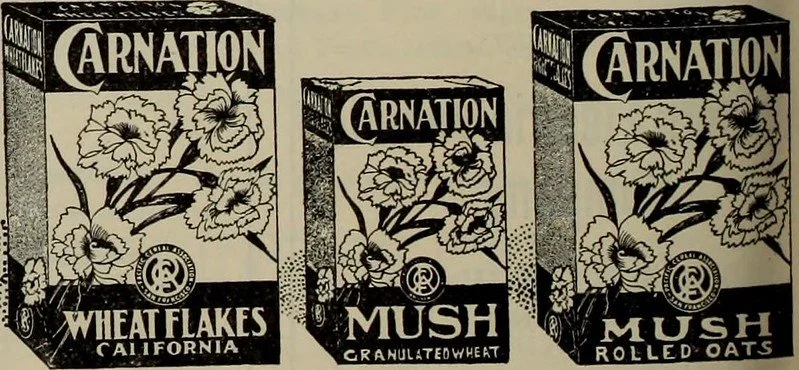
https://www.flickr.com/photos/internetarchivebookimages/14762640901/
The Carnation Mush Sign On Market Street
As stated earlier, the Carnation Mush sign on 1586 Market Street was revealed in 2011 when the abandoned building next door was torn down. Known as the Miramar Apartments, 1586 Market was built in 1912, replacing a block of single story storefronts and warehouses built in the immediate aftermath of the 1906 earthquake. The formerly adjacent neighbor had also been part of this post-earthquake construction wave, having been built in 1907 as a furniture showroom.
Pay attention to those construction dates — they’re important.
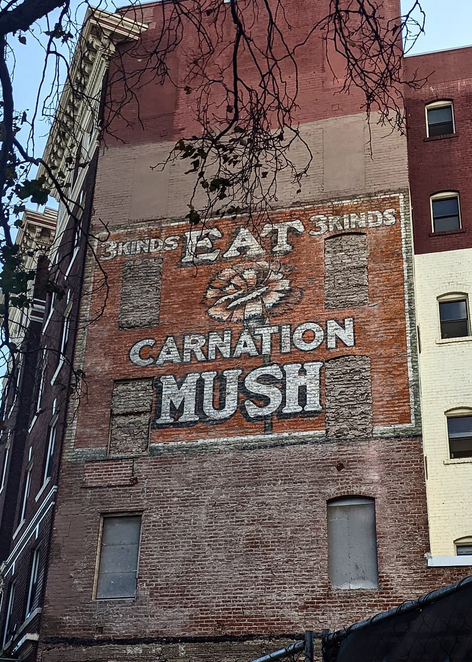
Because they present an odd dilemma… Usually the buildings blocking in old ghost signs are younger, but in this case, the blocking building is the older of the two. The math is not mathing.
My assumption – which I am still looking for concrete information on – is that the adjacent neighbor was originally a single story and was remodeled some time after the construction of 1586 Market and the painting of the Carnation Mush sign; adding an additional two stories of height and covering up the sign. That would explain how the sign was painted and blocked in, as well as why the neighbor’s upper and lower stories did not match.
The OTHER Carnation Mush Sign On Market Street
Between it’s construction in 1912 and April of 1917 there are no known photos of 1586 Market. By the time 1917 rolls around and the earliest known photos of the building were taken, the formerly adjacent neighbor was a full three stories tall and the Carnation Mush sign is no longer visible. This makes it hard to pinpoint the age of the sign using the photographic record. But more on that later…
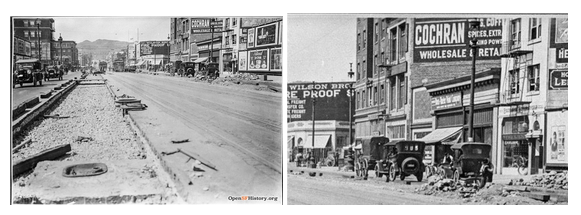
OpenSFHistory / wnp36.01573.jpg
However, a different set of photos taken from a different angle in July of 1917 reveals an interesting fact – there were once TWO matching Carnation Mush signs painted on 1586 Market. Repeating signs across a wall or building was somewhat common in sign painting of this era. Once the sign painter was hired, the design made, the paints mixed, and the scaffolding put up, it was trivially more expensive to have them paint the ad an additional time or two. You can see this marketing tactic on multiple buildings in San Francisco, including 921 Post (two Owl Cigar signs), 725 Geary (also two Owl Cigar signs) and 555 Eddy (two Coca Cola signs)
By repeating the Carnation Mush sign twice on the building they were essentially doubling the sign’s audience. The sign close to street level in the front of the building would have been visible to people immediately passing by; while the one near the roofline in the back of the building would have been visible to people further back on Market and Van Ness streets. Which of course would have been a great way to impactfully market the product on one of the city’s most vibrant corridors.
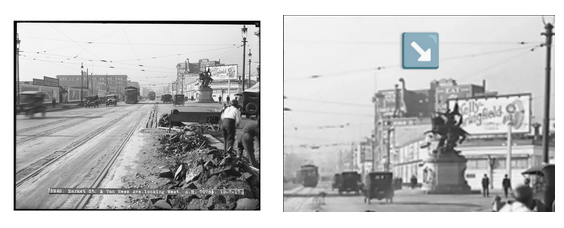
https://sfmta.photoshelter.com/search/result/I0000W4paYEsEH3k
Is there any trace of this second Carnation Mush sign left? Yes! If you look up at the main Carnation Mush sign you’ll see that it has a red/orange ground, a thin white border, a thicker green border, and a tiny line of black. When we look towards the back of the building, where much of the wall has been painted in graffiti abatement paint, we can see a tiny sliver of the same red/orange, white, green, and black pattern sticking out. That is all that remains of the second Carnation Mush sign, which would have been painted over some time after July of 1981, which is when the photo below was taken.
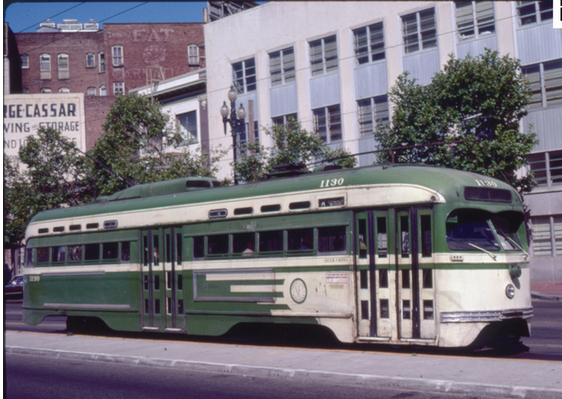
https://opensfhistory.org/Display/wnp32.2714A.jpg
The Carnation Mush Sign In North Beach
In June of 2026 the Verdi Apartments at the corner of Columbus, Union, and Powell was demolished after being deemed in danger of imminent collapse. During the demolition process, a second Carnation Mush sign was revealed on adjacent 575-579 Columbus. While a slightly different layout (rectangular vs square), it does match the color scheme, general design, and artistic quality of the Market Street sign(s) and was likely painted by the same artist, within roughly the same time period.
While the photographic record of this building is spotty, and no historic pictures of the North Beach Carnation Mush sign exist, it is a fairly easy sign to date based on property information. We know 575-579 Columbus was built in 1912 and the Verdi Apartments in 1914, which would place this sign’s painting date between 1912 and 1913.
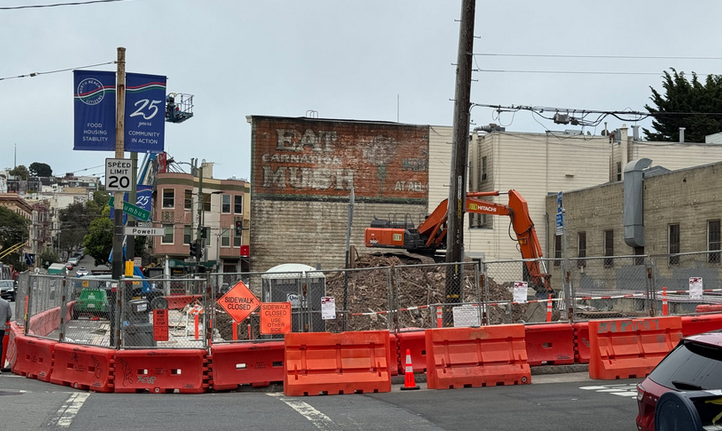
Age Of The San Francisco Carnation Mush Ghost Signs
If we know the North Beach sign was painted in 1912/1913, and the Market Street sign looks like it was painted by the same artist, can we definitively confirm that it was also painted in 1912/1913? Not definitively, but both 575-579 Columbus and 1586 Market were built in 1912, which means both of them would have been available and “on the market” for sign painting in the same time frame. That means it’s possible they were painted at the same time, as part of the same ad campaign. Combined with the stylistic similarities in the two signs, I am 99.99% confident that the Carnation Mush ghost sign on Market Street was also painted in 1912/1913, making it 113 to 114 years old at the time of my writing this in June of 2026.